The Oxford History of Greece and the Hellenistic World by John Boardman & Jasper Griffin & Oswyn Murray
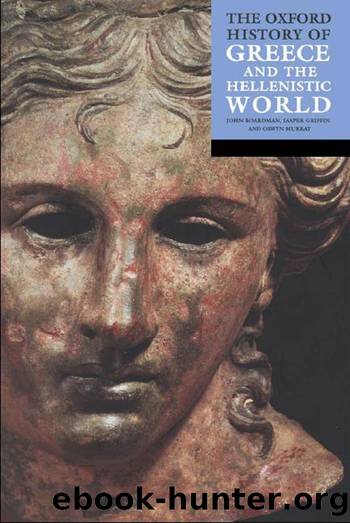
Author:John Boardman & Jasper Griffin & Oswyn Murray [Boardman, John]
Language: eng
Format: azw3
Publisher: Oxford University Press
Published: 2001-05-30T16:00:00+00:00
Family
The Greek family was monogamous and nuclear, being composed in essence of husband and wife with their children; but Greek writers tend to equate it with the household as an economic unit, and therefore to regard other dependent relatives and slaves as part of it. The family fulfilled a number of social functions apart from the economic. It was the source of new citizens; in the classical period the state intervened to establish increasingly stringent rules for citizenship and so for legitimacy: ultimately a citizen must be the offspring of a legally recognized marriage between two Athenian citizens, whose parents must also be citizens; this increasingly sharp definition tended to exclude the more flexible unions of an earlier period. It became impossible for an Athenian to marry a foreigner or to obtain recognition for the children of any other type of liaison: the development is essentially democratic, the imposition of the social norms of the peasant majority on an aristocracy which had previously behaved very differently; for the aristocracy had often married outside the community and thereby determined its own criteria for legitimacy. Indeed Pericles, the author of the first of these citizenship laws, demonstrates the painfulness of the process of adaptation; for, when his legitimate children died of the plague, he was forced to seek from the assembly permission for his children by Aspasia, his Milesian mistress, to be declared legitimate Athenian citizens. Other individuals, often of aristocratic birth, found themselves reclassified in this process as bastards, without either citizenship or rights of inheritance.
For a second function of the family, intimately connected with citizenship, was the inheritance of property. Greek society in general did not practise primogeniture, the right of the eldest son to inherit; rather the property was divided equally by lot between all surviving sons, so that the traditional word for an inheritance was a manâs klÄros or lot. This is one important reason for the instability of the Athenian family, for each family survived only as long as its head, and its property was redistributed on his death. There were of course countervailing tendencies. The common practice of burial in family plots gave a focus for a group of families over several generations, at least among those able to afford the considerable expense of the land and the impressive monuments which were a feature of these group burials: the phenomenon is perhaps a case of the wealthier citizens imitating aristocratic practices. Marriage, even at the highest levels, was endogamous, within a close circle of relatives, in order to preserve family property from fragmentation. More generally, for the same reason, it was common to limit family size; and that could often lead to the absence of male heirs through death, and the redistribution of the property among the wider group of relatives, who also had duties to prosecute a manâs murderer. But in general there is little evidence for extended family groups being important in the classical age.
Another function of the family raises one of the central
Download
This site does not store any files on its server. We only index and link to content provided by other sites. Please contact the content providers to delete copyright contents if any and email us, we'll remove relevant links or contents immediately.
Personalized inhaled bacteriophage therapy for treatment of multidrug-resistant Pseudomonas aeruginosa in cystic fibrosis by unknow(214733)
CONSORT 2025 statement: updated guideline for reporting randomized trials by unknow(102521)
Critical evaluation of the ProfiLER-02 study design and outcomes by Vivek Subbiah & Razelle Kurzrock(102046)
Cardiac gene therapy makes a comeback by Oliver J. Müller & Susanne Hille & Anca Kliesow Remes(101838)
Whisky: Malt Whiskies of Scotland (Collins Little Books) by dominic roskrow(74619)
Unveiling the design rules for tunable emission in graphene quantum dots: A high-throughput TDDFT and machine learning perspective by Şener Özönder & Mustafa Coşkun Özdemir & Caner Ünlü(51002)
A yeast-based oral therapeutic delivers immune checkpoint inhibitors to reduce intestinal tumor burden by unknow(40374)
Covalent hitchhikers guide proteins to the nucleus by Alexander F. Russell & Madeline F. Currie & Champak Chatterjee(40296)
Meet the Authors: Christopher R. Mansfield and Emily R. Derbyshire by Christopher R. Mansfield & Emily R. Derbyshire(40208)
Alkaline-earth metals promote propane dehydrogenation with carbon dioxide through geometric effects: Altering the reaction pathway by unknow(32814)
Induced iron vacancies boosting FeOOH loaded on sustainable Fenton-like collagen fiber membrane for efficient removal of emerging contaminants by unknow(32611)
Efficient electric-field-assisted photochemical conversion of methane to n-propanol exclusively over penetrated TiO2Ti hollow fibers by Guanghui Feng(32530)
Bi2SiO5 nanosheets as piezo-photocatalyst for efficient degradation of 2,4-Dichlorophenol by Hangyu Shi & Yifu Li & Lishan Zhang & Guoguan Liu & Qian Zhang & Xuan Ru & Shan Zhong(32468)
A novel NDIPTA organic heterojunction photocatalyst with built-in electric field for efficient hydrogen production by Jiahui Yang & Baojun Ma & Yongfa Zhu(32443)
Enhanced conversion of methane to liquid-phase oxygenates via hollow ferrite nanotube@horseradish peroxidase based photoenzymatic catalysis by Jun Duan & Shiying Fan & Xinyong Li & Shaomin Liu(32405)
Ordered macroporous superstructure of defective carbon adorned with tiny cobalt sulfide for selective electrocatalytic hydrogenation of cinnamaldehyde by Xiao-Shi Yuan & Sheng-Hua Zhou & San-Mei Wang & Wenbo Wei & Xiaofang Li & Xin-Tao Wu & Qi-Long Zhu(32335)
What's Done in Darkness by Kayla Perrin(27259)
Topological analysis of non-conjugated ethylene oxide cored dendrimers decorated with tetraphenylethylene: Insights from degree-based descriptors using the polynomial approach by A Theertha Nair & D Antony Xavier & Annmaria Baby & S Akhila(26631)
Investigation of mechanical and self-healing properties of hydroxyl-terminated polybutadiene functionalized with 2-ureido-4-pyrimidinone by Mohsen Kazazi & Mehran Hayaty & Ali Mousaviazar(26555)
